Who Will Control India’s Food Grain?
FCI Silos, Corporate Concentration, and the Future of Food Security in India
Whenever agriculture is discussed in India, the conversation usually revolves around farms, farmers, Minimum Support Price (MSP), and agricultural markets. However, there is another crucial pillar of the agricultural system—storage. If the grain produced in the fields cannot be safely stored, production itself loses much of its value. This is why the Food Corporation of India (FCI) has long been regarded as the backbone of India’s food security system.
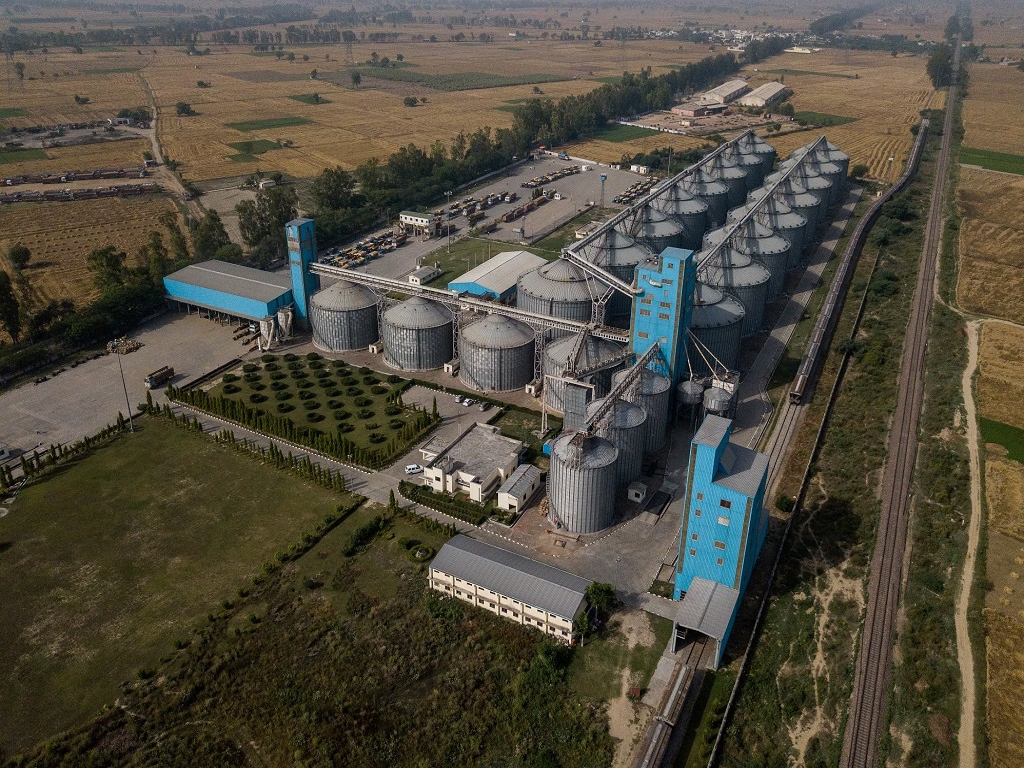
Over the past few years, the central government has promoted a modern silo-based storage system. It has been presented as a major step toward improving food management, reducing grain wastage, and developing modern logistics infrastructure. However, serious questions are now being raised about this project. The issue is not whether silos should be built. The real question is: who will control these silos?
According to an investigative report published by NewsLaundry on May 29, 2026, 110 out of 134 contracts under FCI’s approximately ₹20,000-crore silo program were awarded to just two companies—Adani Agri Logistics and Leap India Food & Logistics. The report claims that out of a total storage capacity of 6 million metric tonnes, nearly 4.65 million metric tonnes are now under the control of these two companies.
The allegation becomes even more significant because, according to the report, FCI had initially proposed an “anti-monopoly” provision aimed at preventing excessive concentration of contracts in the hands of a single company. However, during an important meeting in 2022, NITI Aayog and the Department of Economic Affairs reportedly opposed the provision, leading to its eventual removal.
This is where the debate begins.
The government argues that the modern silo system will strengthen India’s food security. According to information released by the Press Information Bureau (PIB), silo projects will improve grain preservation, reduce storage losses, strengthen quality control, and create more efficient rail-and-road logistics networks.
Technically, this argument is valid. For decades, India has stored grain in open warehouses and temporary structures. Scientific storage facilities with controlled conditions are widely considered a modern solution. Yet the controversy is not about technology—it is about control.
In democratic economies, one principle is considered fundamental: strategic sectors should not become excessively concentrated in a few hands. Food security is one such strategic sector. India’s Public Distribution System (PDS) is among the largest food security programs in the world, and millions of poor households depend on it for survival.
If grain storage, handling, and logistics gradually become concentrated under a handful of private companies, the issue ceases to be merely commercial. It becomes a matter of public policy.
The debate inevitably recalls the farmers’ movement of 2020–21. One of the biggest concerns raised by protesting farmers against the three farm laws was the growing influence of corporations in agriculture. Many feared that weakening the mandi system would ultimately increase the power of large private players. The government rejected those concerns at the time, but the questions now being raised about the silo program have revived the same debate.
A similar controversy emerged in Punjab in 2024 when attempts were made to use private silo complexes as procurement centers. Farmer organizations opposed the move, arguing that it could weaken the traditional mandi system. Following widespread resistance, the decision had to be withdrawn. The episode demonstrated that, for many farmers, silos are no longer viewed merely as a storage technology; they have become a symbol of the future direction of agricultural markets.
Government officials and supportive economists argue that if companies have won contracts through an open tendering process, there is nothing inherently wrong with their success. FCI has also stated in its recent clarification that the bidding process was transparent, competitive, and free from favoritism. According to FCI, the sector is still developing, and artificial restrictions on participation could have discouraged investment and competition.
This argument deserves consideration. Yet critics ask a simple question: if competition was truly robust, why did the overwhelming majority of contracts end up with only two companies?
This brings us to the concepts of monopoly and duopoly. A monopoly exists when one company dominates a market. A duopoly exists when two companies hold such overwhelming influence that other players become largely insignificant. When more than 75 percent of the capacity in a national program is controlled by two firms, many analysts would consider it a clear sign of excessive market concentration.
Another important factor is the National Monetisation Pipeline, under which warehousing and silo assets were opened to greater private participation. Even at that time, experts cautioned that privatization of food infrastructure would require careful regulation and oversight to prevent excessive concentration of power.
Interestingly, documents issued by the International Finance Corporation (IFC), part of the World Bank Group, have described Leap India as a major player in India’s modern agricultural storage sector and highlighted its expanding national silo network.
The central question in this debate is not whether Adani or Leap India are good or bad companies. The more important question is whether India’s food security system should become heavily dependent on a small number of private entities under any circumstances.
History suggests that excessive concentration often weakens competition. Whether in telecommunications, energy, or digital platforms, concentration of economic power has repeatedly raised concerns about market fairness and public accountability. Democratic economies are not only concerned with attracting investment; they are also concerned with maintaining a balance of power.
If storage charges, logistics services, and procurement processes increasingly come under the influence of a few large companies, the government’s own bargaining power could eventually be affected. That is why the concerns raised by farmer organizations cannot simply be dismissed as political rhetoric.
There is little disagreement that India needs modern storage infrastructure. Silo technology is important and necessary. But modernization and private concentration are not the same thing. India needs silos, but it also needs competition. India needs private investment, but it also needs public accountability. India needs efficiency, but it must retain democratic oversight over food security.
As the future of a significant part of India’s food security infrastructure is being shaped today, this debate extends far beyond grain storage. It touches upon broader questions of economic policy, democratic accountability, and the future of Indian agriculture.
Because, ultimately, the issue is not about silos.
The issue is who will control India’s food grain.